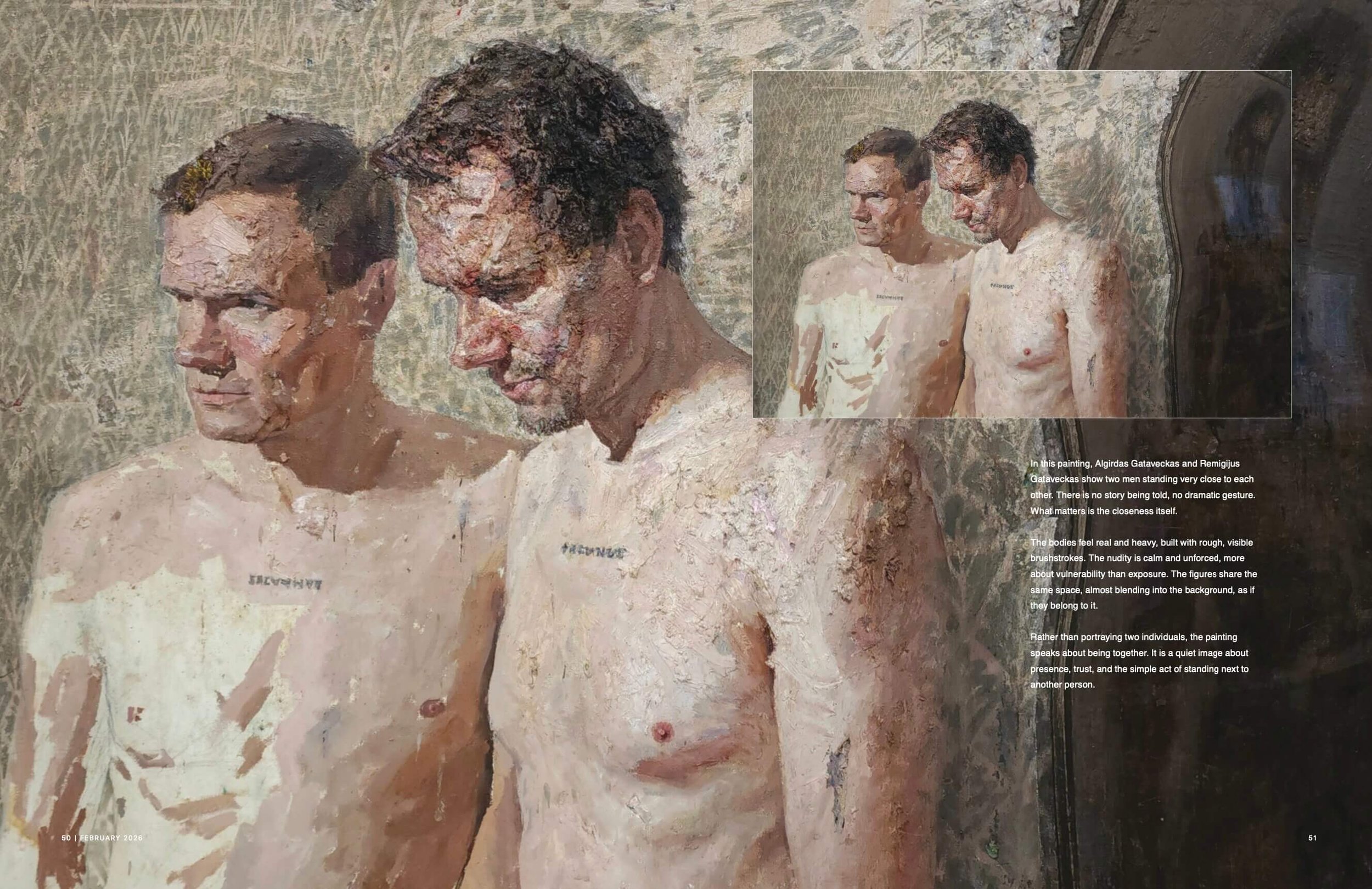
Interview with Algirdas Gataveckas and Remigijus Gataveckas
Your work with Remigijus often challenges the traditional notion of authorship. What is it like to work so closely with your brother in the process of artistic creation?
Creating with my brother is not a method or an agreement. It is a way of life. We grew up together, shaped by the same environment, experiences, teachers, and extreme situations. Because of this, our work does not function as a collaboration between two separate authors, but as two hands of one organism. One begins, the other continues. One corrects, the other supports. There is no fixed structure, only continuous togetherness.
Authorship, for us, is not about names or ownership. It is a relationship that is shared, negotiated, and sometimes uncomfortable. We do not divide tasks logically. We share time, responsibility, exhaustion, doubt, and risk. This directly challenges the romantic idea of the isolated, autonomous artist. Our authorship grows out of lived coexistence, not from an individual gesture or signature.
That is why the question “who made which drawing?” feels foreign to us. Our process is intertwined and inseparable. This way of working often collides with institutional habits, where authorship is expected to be individual and clearly defined. For us, shared authorship is both an aesthetic and ethical position. Not because we want to provoke, but because we simply do not want to work otherwise.
We believe in creation as dialogue, not only between the two of us, but also with the environment, participants, and viewers. This is why working as a tandem is especially meaningful in participatory practices. Two presences allow for deeper connection, shared responsibility, and long-term commitment. Here, authorship is not the affirmation of an ego, but a space of shared experience and trust.
What role do you believe technology and new media will play in your future artistic practice?
Technology does not create anything by itself. Without an idea, even a drawing is only craft. A method or technology becomes meaningful only when it helps articulate an idea more precisely. For us, technologies are working tools, each with its own rhythm, limits, and consequences.
New media can expand possibilities or reach new audiences, but what matters to us is not the medium itself, but what it does to the work, to the maker, and to the viewer. Drawing, photography, printmaking, digital tools, and artificial intelligence exist on the same level. No medium is morally superior to another.
We use technology only when it is conceptually necessary, never as a display of novelty. Artificial intelligence, for example, can be useful or completely inappropriate, depending on the context.
At this stage, drawing remains central to our practice because it requires physical presence, discipline, and time. Long hours in the same space, fatigue, silence, repetition. This duration creates a relationship that later becomes visible in the image.
Artificial intelligence interrupts this chain. It produces an image without bodily time or shared presence. That is why, for now, it does not suit our practice. Not out of fear, but because what matters most to us is not the result, but the process of being together from which the image emerges.
To what extent do your personal experiences, including those from childhood, influence your artistic practice and thematic choices?
Growing up in a children’s home was not a distant biographical background. It was a daily reality that shaped how we think, work, and relate to others. From this experience comes our focus on time, attention, and the relationship between the one who depicts and the one who is depicted.
Many of our works demand slow, uncomfortable looking. This responds directly to the emotional absence and institutional coldness we experienced as children. We want to create situations where the image cannot be quickly consumed. The viewer is asked to stay.
We are drawn to vulnerability and marginal states, not as illustration or commentary, but as presence. We remain with people who are often simplified or reduced to labels. Our autobiographical experience is not an end in itself. It is a method for addressing broader questions of responsibility, power, and human connection.
How would you describe the relationship between reality as we experience it and reality as represented in a work of art?
For us, a work does not begin with an image. It begins with participation. Long-term presence, shared routines, and lived time shape a reality that is not represented, but experienced together.
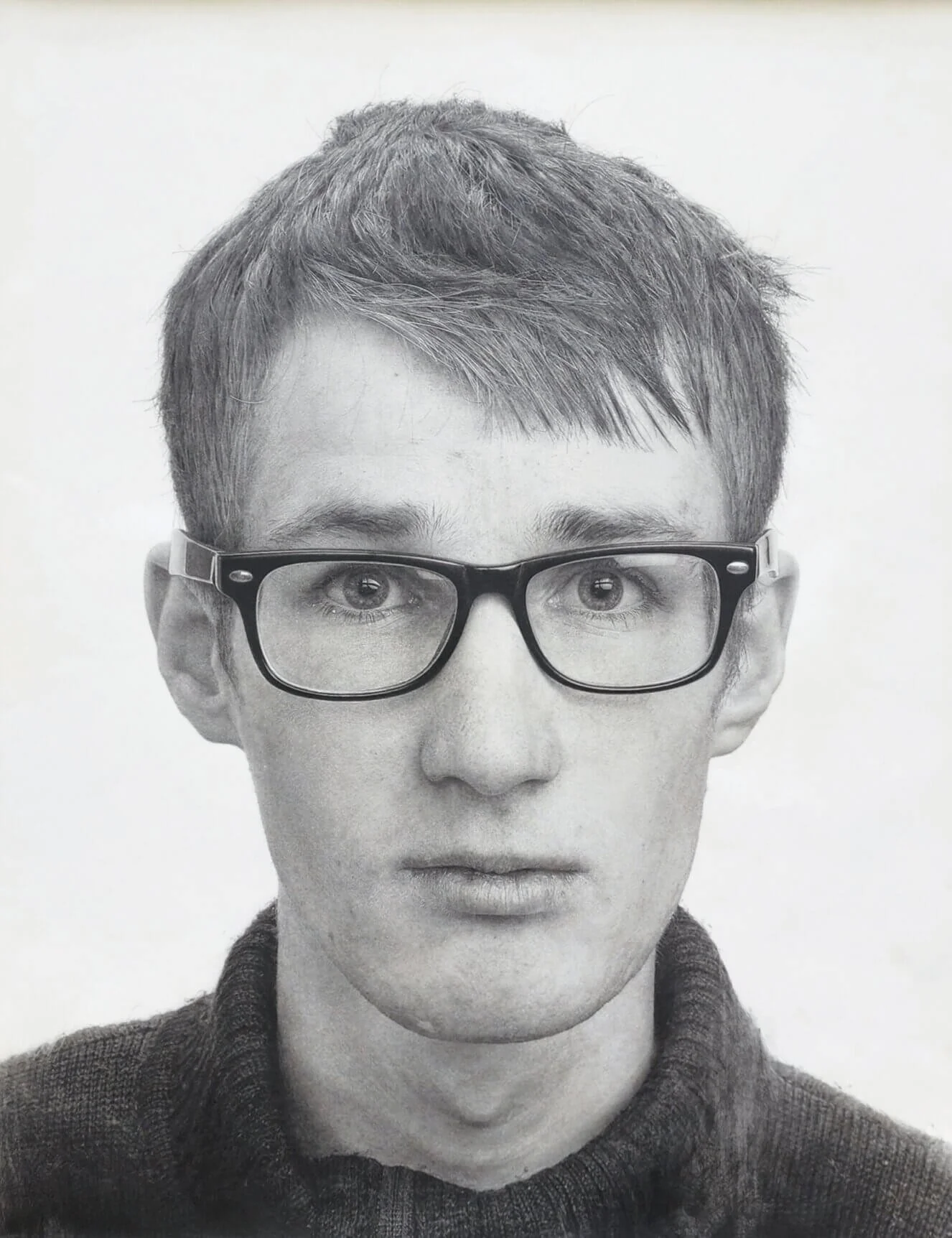
A photorealistic drawing is not realism as style. It is a trace of accumulated time, labor, and attention.
Each detail extends the act of being together. The finished work continues this relationship in the exhibition space, asking the viewer to invest time and presence as well.
Life and art are not separate in our practice. Realism becomes a tool that shifts the gaze and returns dignity and agency to those represented.
Your work reflects on painting beyond its visual outcome. How important is the process for you compared to the final result?
For us, the process is not a step toward the artwork. In many cases, it is the artwork. The image is its trace.
Time, repetition, fatigue, silence, doubt. These are not secondary elements. They are the material of the work. The finished piece matters only if it can carry this duration forward and transmit it to the viewer.
Process and result are inseparable. But if we had to choose, we stand closer to a practice where work is earned through time, presence, and responsibility.
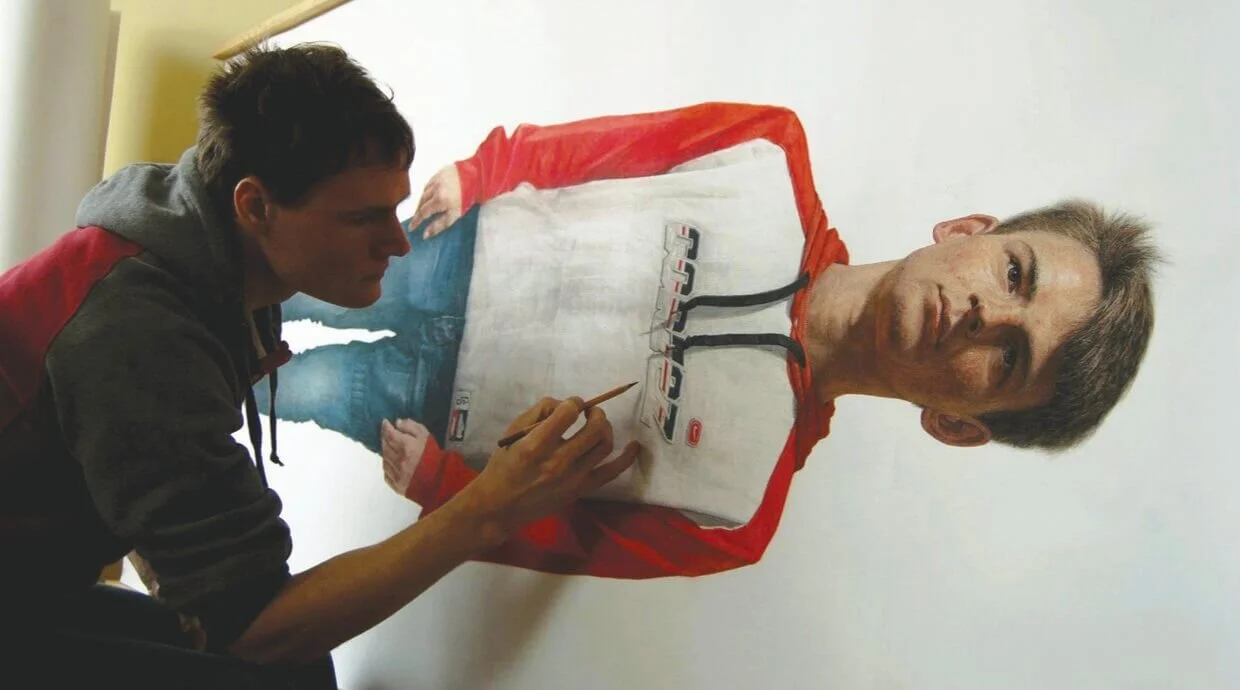
Although their practice originates in autobiography, they do not seek merely to revisit their childhood in state care institutions. Rather, they examine broader structures of visibility, social exclusion, and power. Working as a creative duo, they build authorship through dialogue, shared responsibility, and active inclusion.
Because care and neglect are lived realities for them, their projects are rooted in long-term engagement. Living within communities, sharing daily life, and sustaining coexistence form the foundation of their creative process. Presence over time is essential to their practice.
Their work creates situations in which art enables communities to shape their own public image and question imposed representations. By blurring the boundaries between art and lived experience, they work from within rather than from the outside.
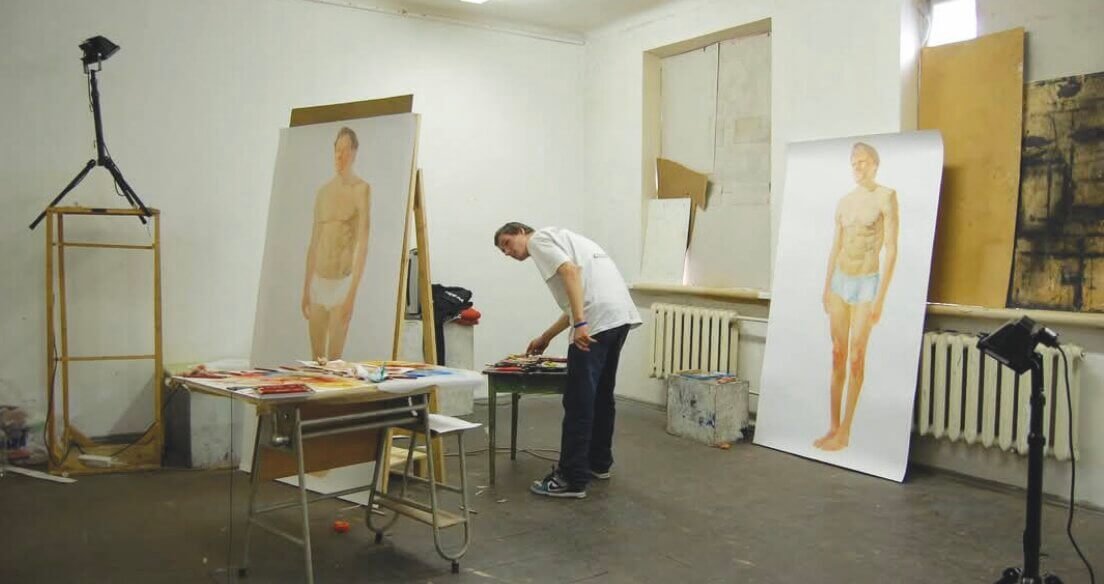
As they state, “Their work is built on shared presence. Art is not something they make about others, but something that emerges from living, working, and taking responsibility together.”
The slow pace of their hyperrealistic drawing turns each work into a document of relationships formed over time, resisting the accelerated consumption of images. Drawing remains central to their practice, evolving into other forms when the concept requires it.
They call this approach organic pixelism: hand-drawn hyperrealism in which each mark becomes a trace of time, attention, and human connection.
They use hyperrealism as a visual strategy to restore visibility to marginalized individuals. In their practice, ethics and aesthetics are inseparable. Returning completed works to co-creators affirms artistic value both as shared ownership and as an act of dignity.
What kind of reaction do you hope to provoke in viewers of your work, especially when it disrupts expectations of realism?
We are not interested in strong reactions or instant emotions. What matters to us is interrupting habitual ways of looking. When viewers realize that an image they assumed to be immediate is the result of long manual labor, they are confronted with time. If they stop, return, and recognize their own automatic gaze, the work succeeds.
Realism, for us, is not about beauty. It is an ethical demand for attention, presence, and responsibility.
Do you think the viewer needs to know your personal story in order to better understand the works?
The viewer does not need our biography to experience the image. But to understand the work as a participatory practice, some context is often necessary.
Our personal history is not a narrative. It is the foundation of a method. Without this context, the work risks being read as representation rather than as a trace of long-term responsibility and shared time.
What themes or directions are you interested in exploring next?
We are often associated with realism, but realism is neither our goal nor our limit. It is one language among many.
Our practice moves between drawing, painting, sculpture, objects, spatial interventions, and public work. We choose form based on what the idea demands, not on tradition or style. What interests us is remaining open, working across scales and contexts, always loyal to the idea rather than to a single medium.
Is there any medium or format you have not yet tried but are curious to experiment with?
We have not worked with music, theatre, or poetry, but we do not exclude them. If an idea required those forms, we would be open to them. The medium matters only insofar as it allows the idea to be realized with precision.
How would you like your work to be read or interpreted several decades from now?
I would like our work to be influential. What matters to me is that a future reader understands that a work is not only “about” something, but that it actively does something. It shifts a boundary and changes a habit of looking. It is less important that every detail is interpreted exactly as I intended, and more important that the underlying principle is recognized: that creation can function as a tool for moving human and social consciousness forward.
If, decades from now, it is clear that our work has contributed to a broader understanding of art, leaving a trace not only in the history of exhibitions but in the way people think, then it will have achieved what it was made to do.
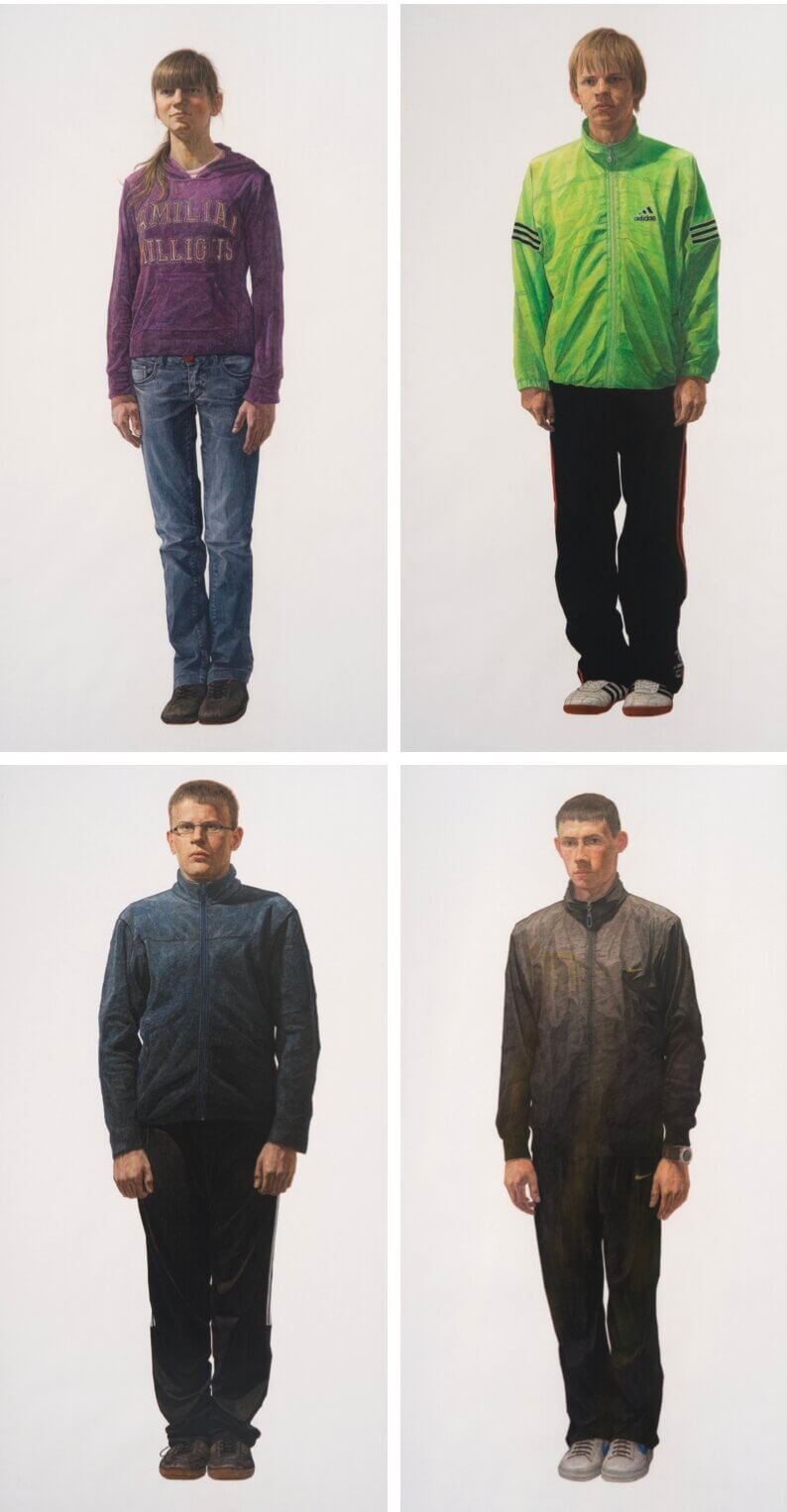
“Many of our works ask for slow, sometimes uncomfortable looking. We want to create images that cannot be consumed in a glance, images that ask the viewer to stay.”
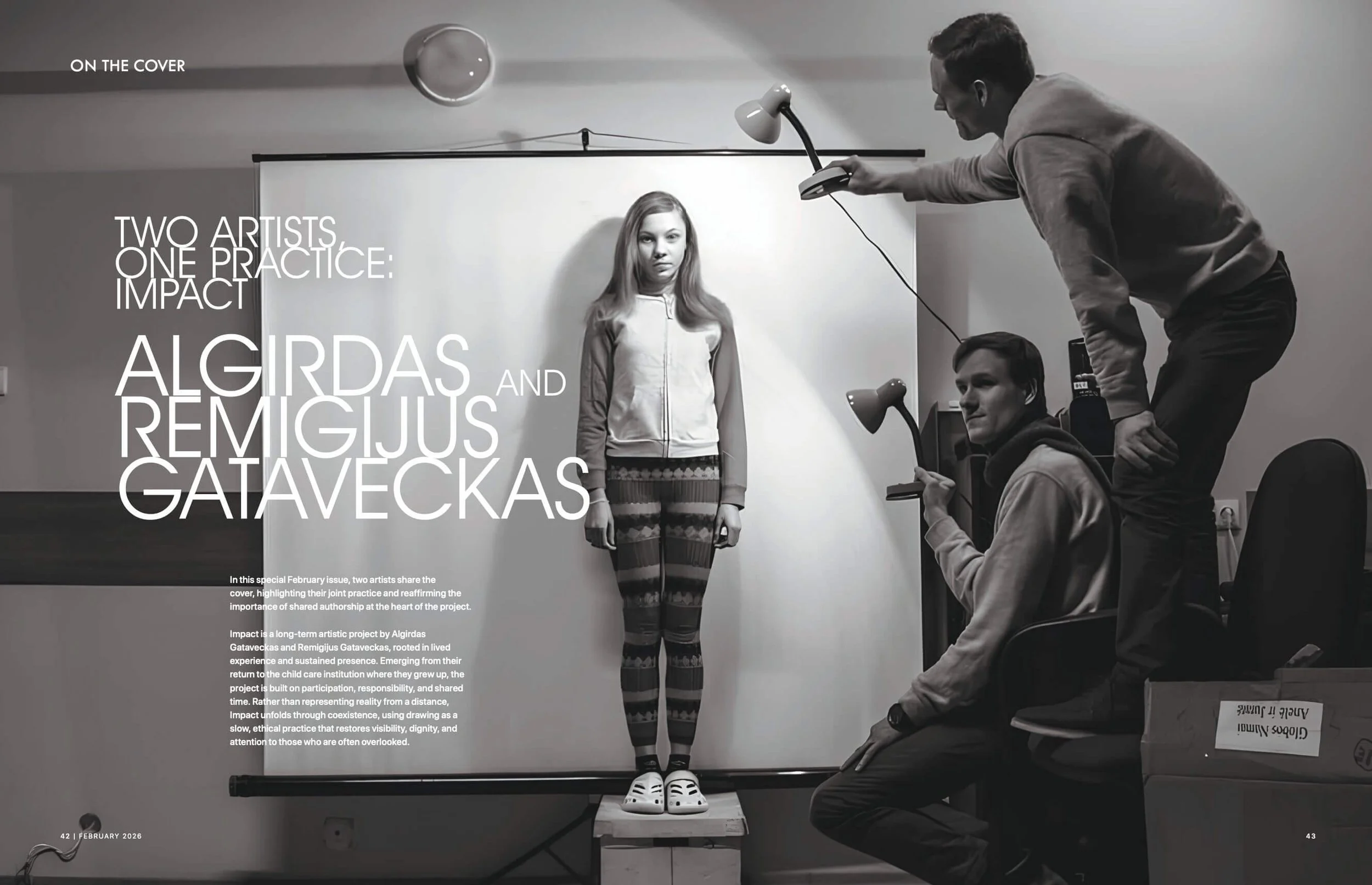
TWO ARTISTS, ONE PRACTICE: ALGIRDAS AND REMIGIJUS GATAVECKAS
The artists’ creative practice originates in a shared life experience: their childhood and adolescence spent in the largest child care institution in Lithuania, the Alytus Child Care Home. Shaped by emotional deprivation, social exclusion, and institutional rigidity, this environment became not only a source of trauma but also the foundation of their artistic vision. From this experience emerged Impact, a project conceived not as representation, but as presence, relationship, and responsibility.
The first phase of the project involved a five-year return to the care home, not as visitors or figures of authority, but as active participants in everyday life. They lived there, shared routines, activities, celebrations, and conflicts, and became part of the community as equals. This prolonged presence, often questioned by the institutional system itself, transformed both the residents and the artists.
Rather than observing from a distance, they engaged in a shared human space where belonging was built through time and commitment.
Alongside this participatory and anthropological practice, drawing became central to the project. In a temporary studio inside the institution, the artists created life-sized portraits of eight young people living in care. These works, developed over periods ranging from two to eleven months, were not isolated aesthetic exercises but extensions of daily coexistence. Drawing functioned as a form of manual labor, slow and repetitive, where the goal was not to produce an image but to sustain presence over time.
The process involved long posing sessions, intimate conversations, and shared silences. Each participant chose how to present themselves, what to wear, and how deeply to engage, without artistic imposition. As a result, the portraits carry personal stories, physical traces, and everyday details that speak not only about individuals but about a broader institutional reality. The images resist quick consumption and instead demand attention, returning dignity and visibility to those who are often overlooked.
The project deliberately avoided forced creativity. Participation was voluntary, and its value lay in cultivating perseverance, concentration, and responsibility. The portraits were gifted to the young people who posed for them and later sold with their consent, supporting their transition into independent life. This gesture reinforced the project’s ethical foundation, positioning art as a shared social practice grounded in cooperation and accountability.
Formally, the works resemble photographs, yet every detail is drawn by hand using what the artists describe as “organic pixelation”: a slow, analog reconstruction of a digital image. This method opposes automated image culture and transforms hyperrealism into a critical strategy. It functions as a visual trap that exposes aesthetic and social prejudices, mirroring the same mechanisms of devaluation that marginalize children within institutional systems.
Impact extends beyond the context of child care homes. It reveals broader social wounds rooted in post-Soviet realities and raises fundamental questions about the gaze, collective responsibility, and human connection. Ultimately, the project is not about institutions, but about what it means to be seen through sustained relationship, time, silence, and presence.