Interview with Anna Wypych
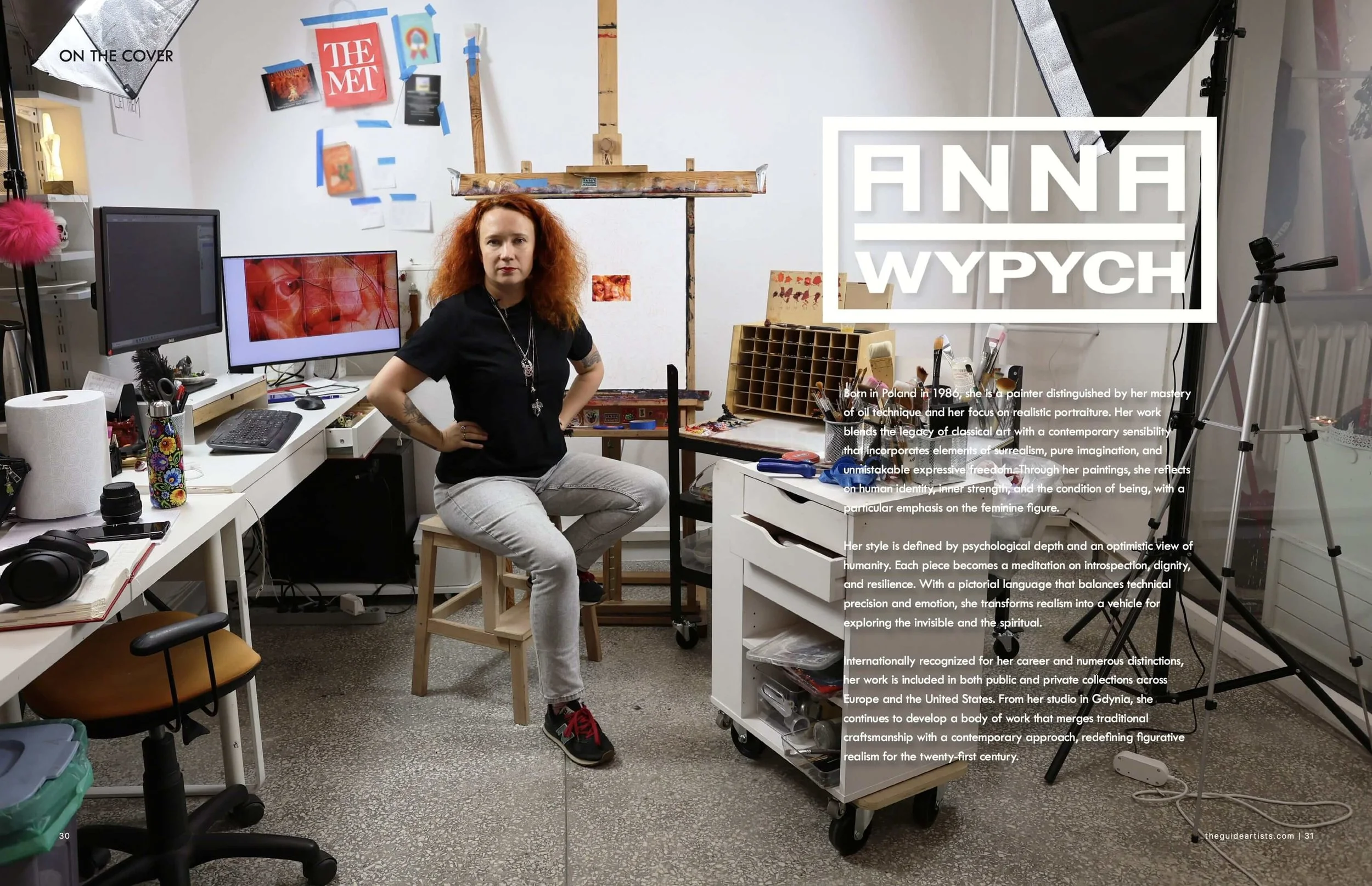
Exclusive Interview with Anna Wypych
“In my artistic practice, I like to speak about various matters – in different ways and using diverse means of expression. I work on multiple series simultaneously, often over many years. I would like to begin by briefly sharing my artistic journey, and then introduce my current projects.”
You studied at the Academy of Fine Arts in Gdańsk, where you graduated with honors. Could you tell us about your artistic training and which moments you consider most decisive during your early years as an artist?
A profound influence on my artistic path came from my professors at the Academy of Fine Arts in Gdańsk. First, Professor Jacek Kornacki, under whom I studied the fundamentals of painting, and later Professor Maciej Świeszewski, whose studio I chose for my diploma.
It was under his guidance that I created large, multi- figure compositions. My ambition and dedication grew significantly during that time, largely thanks to his inspiring role.
The most important turning point, however, came in 2013 with a decision I made while working on Self- portrait with Tattoo. By then, I had already taken my first steps in the art market and experienced my first setbacks. I found myself at a difficult moment in life and decided to take a risk: to fully commit to what I truly wanted. I chose realism, I chose myself — and I chose to look abroad, as the local art market at that time had offered me little support.
I began to search for my place more broadly. First, I was noticed by the then-director of MEAM in Barcelona, who has since passed away. Shortly after, I entered the American art scene through Principle Gallery, with whom I continue to collaborate to this day.
In your first stages, you worked with large, complex figurative compositions, and gradually you reduced the format, focusing your attention on female portraits that convey inner strength. What motivated this change, and how did you experience that creative transition?
In the early stage of my career, I worked on large, multi-figure compositions, which I called “Giants.” Interestingly, even then one could already see elements that continue to return in my painting today. These works were created under the strong influence of the Academy, and after graduation I began searching for my own path.
I wanted to paint realistically, and realism requires time and attentiveness. On such large formats, I would have had to simplify in order not to prolong the process— and that was something I didn’t want to do. The shift therefore came naturally: I devoted the same amount of time to each painting, but the format gradually became smaller. Alongside this, I started to focus on more intimate perspectives and close-up scenes.
That was the moment when my own artistic language began to take shape—no longer supported by professors, but guided by my inner choices and the need to create art on my own terms.
We read that your paintings often emerge from your personal reflections, as well as readings in poetry
or philosophy. Could you share some recent ideas or readings that have notably influenced your latest works?
It would be difficult for me to point to a single specific source of inspiration. I read a great deal—and in very diverse areas. Last year I set myself the challenge of reading 100 books, and I managed to reach 101. I turn to audiobooks, which I listen to while painting. It is one of the great privileges of my profession that I can combine painting with such an intense immersion in reading.
I like to move between different fields: I might begin with non-fiction, then reach for the history of medicine or psychology, sometimes weave in a guidebook or something connected to philosophy, and afterwards switch to fantasy—before returning again to fact-based or historical literature.
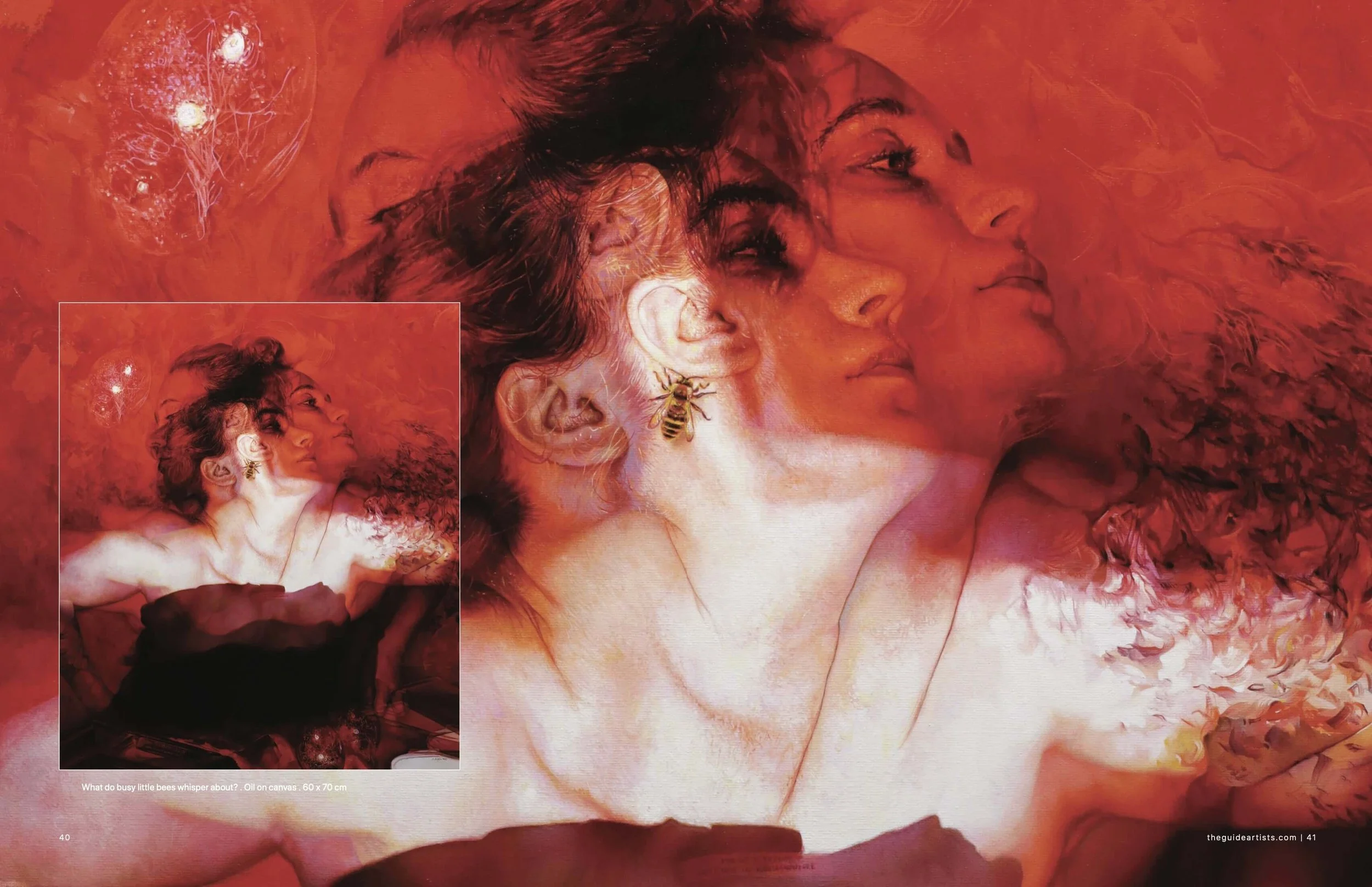
Although philosophy does not dominate my reading, it is the one that inspires me most. Philosophy—“the love of wisdom”—asks questions about reality, existence, knowledge, morality, and values. For me, it is above all a space for reflection and critical thinking, which I find deeply compelling. I can relate this to my two most recent series. “Red” is a reflection on the juxtaposition of two contrasting approaches: the rational, analytical perspective—“the lens and the eye”—and the emotional one. In the world before the age of artificial intelligence and algorithms, and machines the first was considered the more valid path, while the second was often dismissed as worthless. Today we discover that a reevaluation is needed: what is soft, emotional, and delicate proves to be irreplaceable by machines—and it is value.
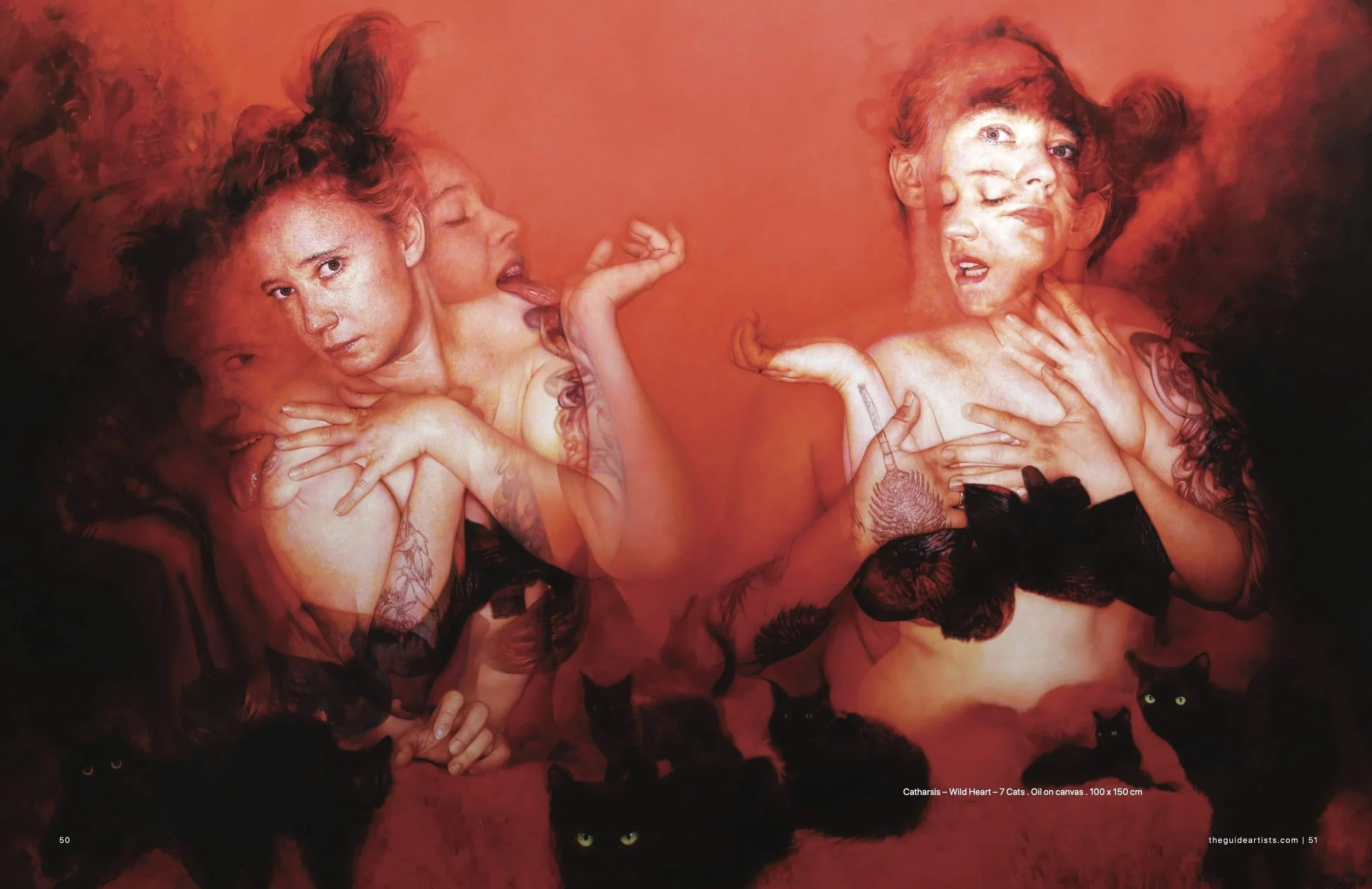
Meanwhile, “Tales” grew out of my own reevaluation. Until recently, the starting point of my art was always myself—my life, reflections, and experiences, which over time transformed into something more universal, open to others. Now, as I approach forty, that formula has run its course. “Tales” no longer begin within me, but beside me. They are abstract stories, sometimes sharp in expression, open to interpretation.
Each viewer may see / interpret something different in them—and what they see tells a great deal about themselves. That, for me, is the most captivating aspect.
You combine classical techniques and realism with surrealist or hyperrealist elements and touches of expression. In addition, your works are defined by intense gazes, symbolic use of elements such as eyes, hearts, insects, or fruits, and a palette that contrasts warm colors with dark backgrounds. How would you define your style, and what role does symbolism play in your work?
This is a very difficult question for me. I know it is often said that having a recognizable personal style is important—it certainly helps in a career. However, in practice, this often means painting the same things over and over again. In my case, that doesn’t work, because I quickly start to feel trapped. I am capable of creating very different works, in very different ways, and I now know that this is my strength. It is not worth giving up your own assets to follow something that goes against yourself.
That is why I cannot fully define my style—I don’t think about my painting in that way. I do, however, always enjoy hearing what others perceive as the unifying elements in my work.
Certain symbols and motifs reappear in my paintings, but I wouldn’t say that any of them dominates. What has always been important to me is that my works are about something—this is the role of symbolism in my art. I enjoy reflecting and exploring ideas, and the result of these reflections becomes the content of my paintings. One single idea or thought is never enough to define my entire body of work; I like to change perspectives, to experiment. My painting is a living creature—or a living mind.
Your protagonists are often strong women, with determined expressions that transmit self- affirmation and inner strength. What draws you to these figures, and how do you choose the women you portray?
When I work on a painting, it always begins with a word or idea. Over time, this develops into a vision that takes on a specific face—the face of a particular person.
I work both with professional models and, occasionally, with friends or completely unfamiliar people whom I meet by chance or see online. There is no great mystery here—sometimes I simply feel that someone has the right energy for my vision, and I invite her for a photo session.
At the same time, I make a point of working with different models—I don’t want to base my entire practice on a single person. I maintain good relationships with them and often return to work with them after a few years, but I try not to schedule two sessions in a row with the same model.
Each painting begins with a clear concept: you carry out photo sessions with your models, and much of your process develops from these images. Could you describe your creative process, from the initial inspiration to the finished painting?
Once I have a vision—meaning I know what the painting is about—and have chosen a model, I begin preparing for the photo session. I usually plan in detail several sets, gestures, objects, and symbols that I will use—everything is carefully thought out. The session itself is a “living organism,” and not everything can be predicted. Also the model brings her own character and sensitivity. So, while I usually have a detailed plan, I remain open to changes and don’t feel the need to follow it rigidly. I try not to miss any opportunity.
The session is very demanding for me, but it typically produces around a thousand photographs, so the effort is worth it. I then work from these photos. Sometimes fewer paintings emerge than I initially planned, and sometimes the photos are so inspiring that I create several additional works.
Once the project is ready and I feel it is “the one,” I begin painting. First, I sketch everything square by square with a watercolor pencil. Then I apply an acrylic underpainting, though not always. After that, I build up several to a dozen layers of oil paint. Each layer adds detail, depth, and helps “set” the colors and space. Lately, I plan areas where I leave room for freer brushstrokes, so that each painting contains both highly realistic and more spontaneous elements.
Finally, there are the less enjoyable stages—after a waiting period, I varnish and photograph the finished painting.
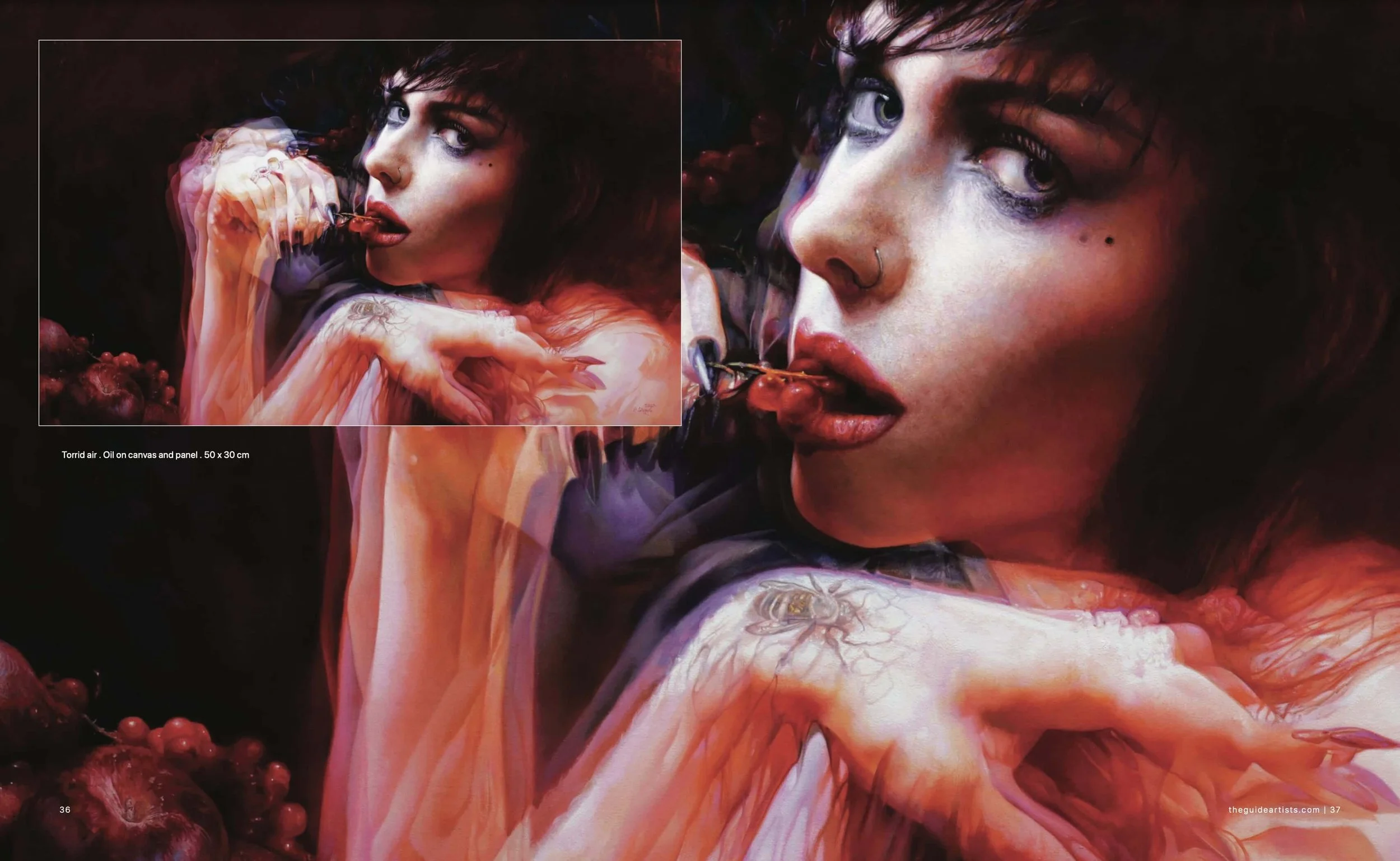
Your latest works address themes such as spirituality, femininity, motherhood, capitalism, and postpandemic challenges. You also experiment with repetitions and symbols such as the eye, heart, or bee. Could you talk about these recent explorations and what you want to express through them?
I have already mentioned the series “Red” and “Tales.” Now I would like to say a bit more about my very latest cycle – “Women-Flowers.” So far, only a few paintings have been created, and the series is still taking shape.
I think of it as a kind of counterbalance to “Tales,” which can be sharp and heavy in expression at times. Here, I aim to create something beautiful, light, and good – like a flower bought for oneself, purely for pleasure, without any occasion.
At the same time, flowers carry rich symbolism – connected to femininity, beauty, but also fragility, delicacy, and transience. Flowers can also be used to make the deadliest poisons. And a female painter / artist who paints flowers is a huge teme in itself, one that could be explored in countless contexts. I enjoy the subtle irony and the depth of meaning that flowers embody.
I am also very drawn to the way I combine flowers with models. I like it when they interact on a fundamental level – it is not simply layering one over the other or a sdirect blending, but a kind of deep deconstruction and rebirth.
In “Women-Flowers,” there is depth and authenticity, but also lightness and pleasure. The series is still very much in the process of formation.
The “Boson” cycle, inspired by the Higgs boson, explores freedom and human potential. What led you to develop this series, and how does it connect with other themes in your work?
The “Boson” series was created at a particularly significant moment in my life. At the beginning of preparations for a very important solo exhibition at Principle Gallery in Charleston, I discovered that I was in long waited pregnancy. I did not give up on the project and managed to balance everything. I accomplished what I had set out to do, and after the birth of my son, our whole family attended the exhibition opening. On- site, we faced a hurricane, which forced the event to be postponed. Despite the challenges, the exhibition was a great success.
After such an intense and extremely demanding period, I should have taken a break — now I realize that. Yet, I felt the need to create something grand and ambitious. I pushed myself beyond my limits once again. This is how the “Boson” series was born, exploring human freedom and potential. The inspiration for the series came from the Higgs boson, known as the “God particle,” which gives mass to other particles. I embraced it as a symbol of freedom — the element that makes us who we are. Each painting in the series became a treatise on a different aspect of freedom, from difficult choices in Black and White Play to reflections on time in The Lady of Time. All the works were accompanied by elaborate texts and poems. I wanted to capture the essence of freedom. Paintings such as Too Sweet to be Serious and Double Freedom explored human relationships and their impact on the experience of freedom. “Boson” became not only a philosophical journey but also a tremendous technical challenge. At that time, I was deeply captivated by the allure of hyperrealism and technical perfection — all while painting in my living room with my crawling baby at my feet. It was a challenge in every possible sense of the word.
You are a member of the International Guild of Realism (since 2020) and a Living Master of the Art Renewal Center (since 2015). Your work is part of permanent collections including the Muskegon Museum of Art (USA), MEAM Barcelona, galleries and museums in Poland, and The Guide Artists. How have these recognitions and collections influenced your career and your vision of art?
I regard these distinctions and the presence of my work in collections as important points of reference, affirming that the path I have chosen makes sense. Being part of the International organisations and receiving the title of Living Master from the Art Renewal Center has given me a sense of grounding within the broader tradition of realism, as well as the opportunity to engage in dialogue with artists around the world.
The fact that my works are included in museums and permanent collections is incredibly satisfying. The paintings begin to live their own lives, and by becoming part of public collections, I have the certainty that they will be remembered forever. There will always be someone caring for them, ensuring they do not disappear.
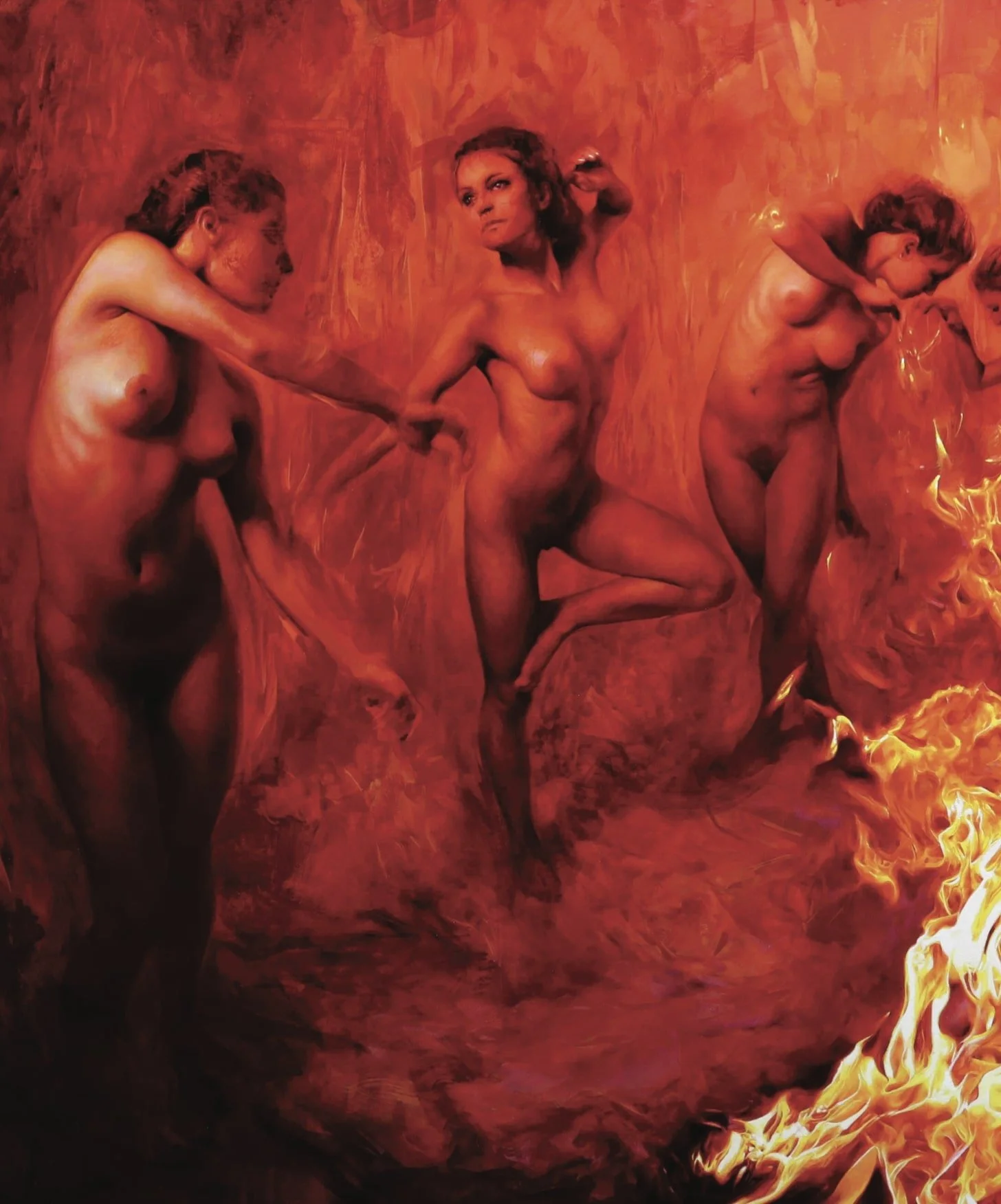
“In my work, I value freedom and openness. I allow myself diversity – I am able to create both classical, calm paintings and expressive, energetic visions. I feel close to both surrealism and darker moods, as well as marine and portrait painting inspired by the old masters. I love this freedom – it is what allows me to constantly rediscover and grow as an artist. ”
This year, 2025, you are participating or exhibiting in important events such as “Figurativas 2025” at MEAM, “Flourishing Through Beauty” in Denver, and “Mixed Reality” in Alexandria (VA), among others. What does it mean to you to take part in these exhibitions, and how do they connect with your artistic development?
For me, participating in these exhibitions is an important step in my artistic development, as each one opens a different context. “Figurativas 2025” at MEAM represents prestige and a confirmation that my painting has a place in the international dialogue on realism. “Flourishing Through Beauty” in Denver provides space for reflection on what beauty is and how it can shape our sensibilities. “Mixed Reality” in Alexandria allows me to juxtapose realism with other forms of expression and to see my work in a new light. I regard all these events as opportunities for conversation, exchange, and further growth.
You are a mother, wife, and full-time artist. How do you balance these roles, and in what way does motherhood and your personal life influence your painting?
I really don’t like this question. Somehow, no one ever asks male artists how they manage to balance fatherhood with their professional work. It feels unfair. At the same time, I know and remember how important the reflections of other women artists were to me when I was at the early stages of motherhood. So I will answer.
I don’t know. Somehow I manage to combine these roles, but I don’t have a single piece of advice. Everything is constantly changing, and one navigates it like a surfer on the waves. There are good moments, but there are also difficult ones – and importantly, both pass, and that is certain. So enjoy good ones, and when it is all bad, remember that it will end.
At the beginning, motherhood permeated my work, and a few paintings directly reflected it. Later, themes “inspired” by it emerged, and now it appears less frequently in my art. I suppose I simply returned to myself, redefined who I am, and everything settled into place naturally.
What are your projects or ambitions for the future? Do you see new directions or themes you would like to explore in your work soon?
Ahead of me is the year 2026 – exactly 15 years since I defended my Master’s degree at the Academy of Fine Arts. On this occasion, a book documenting my artistic journey during this time will be published and available through The Guide Artists Brand. I am also planning several exhibitions, including a “2 person show” at Principle Gallery in Charleston.
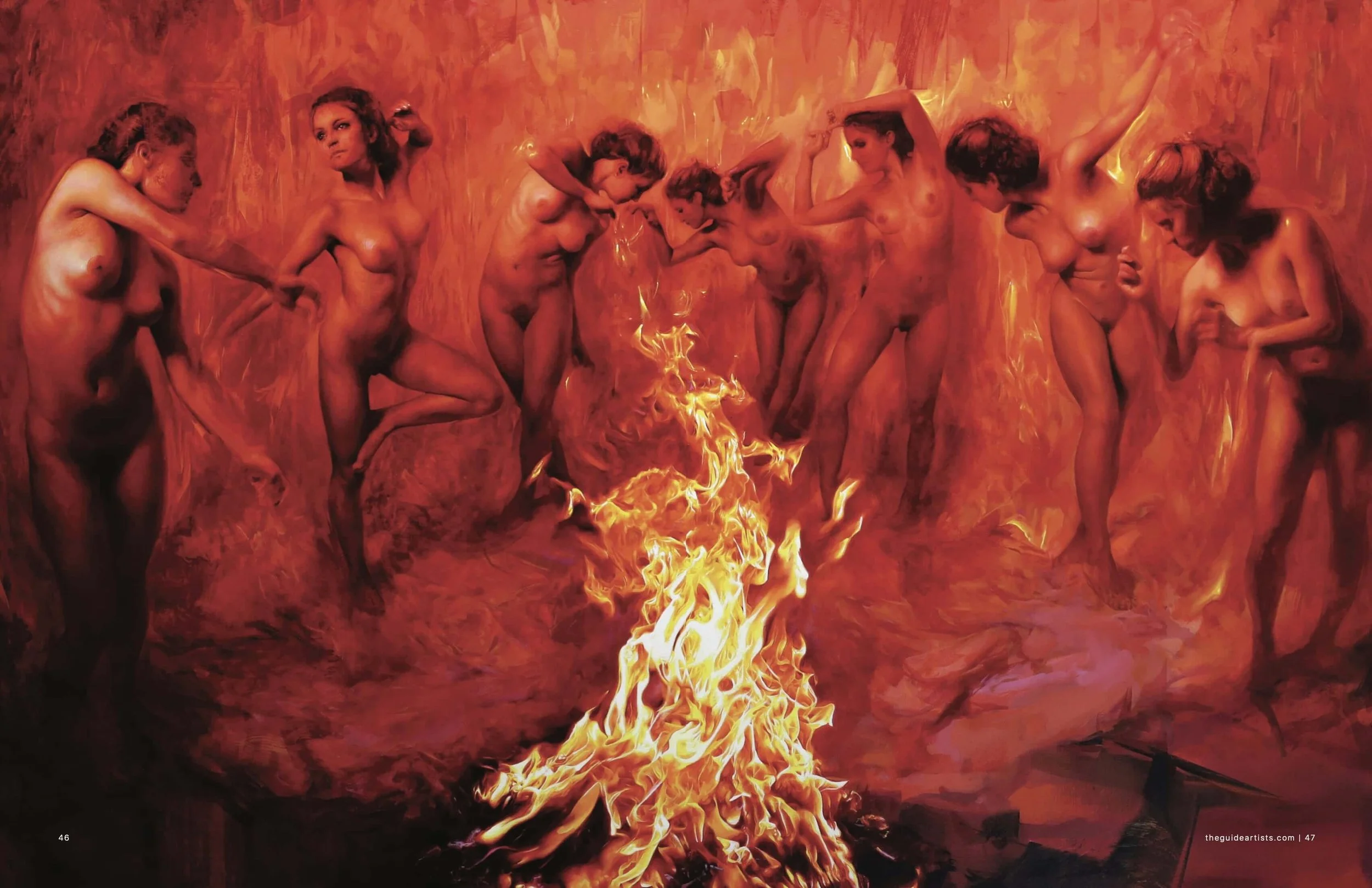
In my creative path, I will certainly continue developing the series “Tales/Histories” as well as the newest “Women-Flowers.” Projects such as “Multiplications,” “Water,” and “Fire” will also remain part of my work and continue to evolve.
At this moment, it is difficult for me to think about future ambitions, as I am dealing with some personal challenges, so for now, my plan is simply to “survive”. After that, we’ll see what comes next. One thing is certain – I will continue to paint a lot.