Exclusive Interview with Edith Ruiz
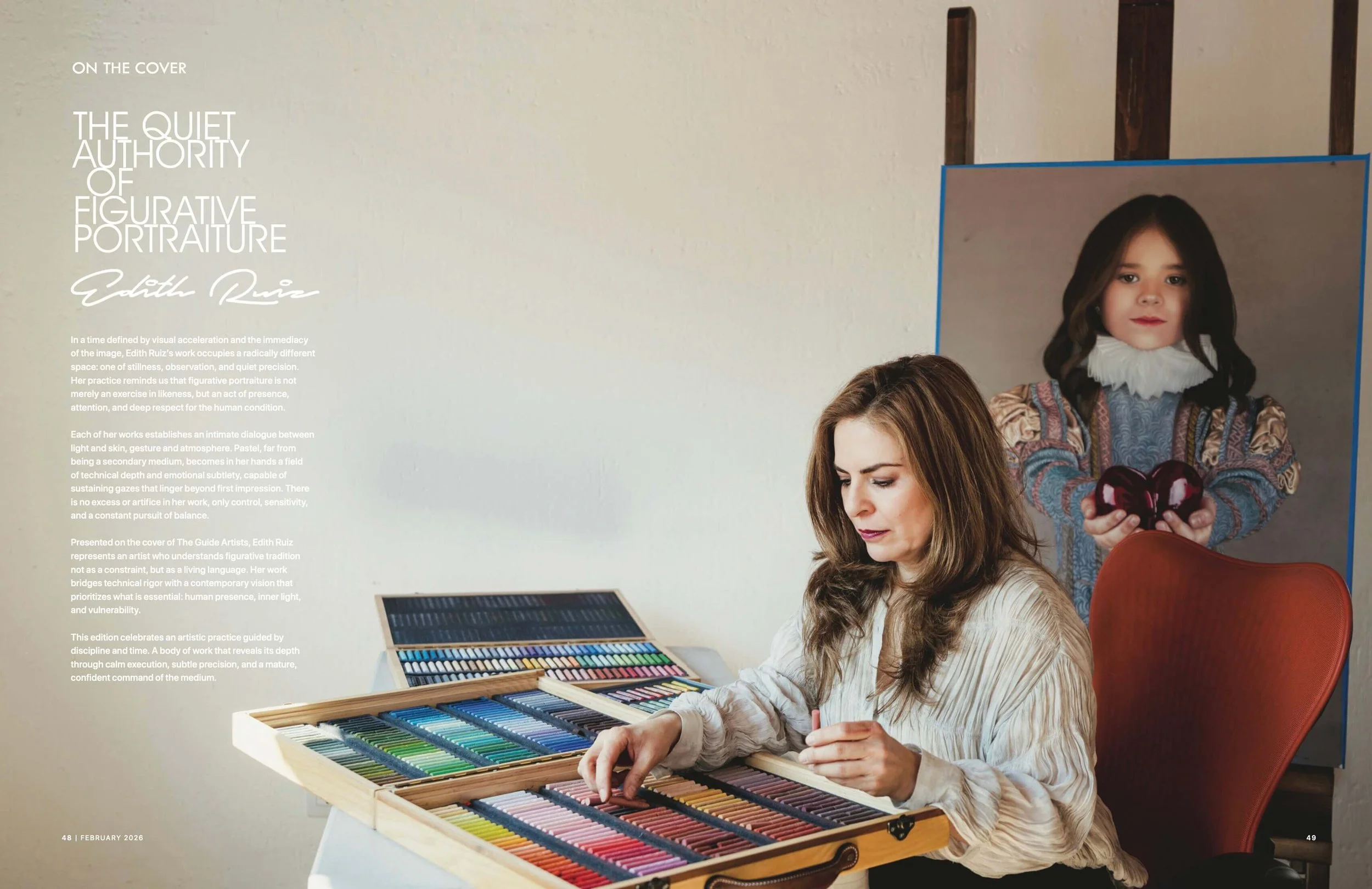
In a time defined by visual acceleration and the immediacy of the image, Edith Ruiz’s work occupies a radically different space: one of stillness, observation, and quiet precision. Her practice reminds us that figurative portraiture is not merely an exercise in likeness, but an act of presence, attention, and deep respect for the human condition.
Each of her works establishes an intimate dialogue between light and skin, gesture and atmosphere. Pastel, far from being a secondary medium, becomes in her hands a field of technical depth and emotional subtlety, capable of sustaining gazes that linger beyond first impression. There is no excess or artifice in her work, only control, sensitivity, and a constant pursuit of balance.
Presented on the cover of The Guide Artists, Edith Ruiz represents an artist who understands figurative tradition not as a constraint, but as a living language. Her work bridges technical rigor with a contemporary vision that prioritizes what is essential: human presence, inner light, and vulnerability.
This edition celebrates an artistic practice guided by discipline and time. A body of work that reveals its depth through calm execution, subtle precision, and a mature, confident command of the medium.
Looking back, how do you remember your first encounter with art, and at what point in your life did you clearly realize that painting was not just a passion, but the professional path you wanted to follow?
As a child, it felt completely natural to me to represent objects and places from real life on canvas, since my father and older brother painted landscapes and still lifes. From an early age, I drew cartoon characters as a pastime. I always enjoyed drawing, but I saw it simply as a hobby.
My life followed its course without me being consciously aware of that inner calling to express myself through drawing, and without knowing that it would eventually lead me to become a painter. I began my professional life working in offices, holding administrative positions. In my free time, that artistic calling would resurface, and I would take the opportunity to draw from time to time.
I got married. I had a daughter. I got divorced. I was 38 years old, and for the next two years I was forced to devote all my attention and energy to covering the basic needs of my eight year old daughter and my own.
At the age of 40, for the first time, I stopped to reflect on the direction I wanted to take, and it was then that my inner calling gave me the answer. I decided to take drawing classes and discovered that this was my path, as I was amazed by the fluidity and ease with which I could create figures and later realistic portraits, all in black and white using pencil and charcoal. The decision was clear. From that moment on, I would dedicate myself to art.
Your artistic training began formally in Mexico City. Which experiences, teachers, or moments from that period do you consider decisive in shaping your artistic identity?
The Chamber of Deputies in Mexico City, where I worked, organized art exhibitions on a regular basis. As if it were a sign from the universe, I was made responsible for preparing the space where the painting exhibitions took place. Every time I saw the works on display, I would imagine, with excitement, that one day I could do the same.
I discovered that one of the exhibiting artists, Roxana Wiley, taught painting and drawing classes. I contacted her and began studying with her. That marked the beginning of my formal training. I continued working full time at the Chamber, attending classes for just two hours a week.
My parents were amazed by my drawings. Both they and Roxana encouraged me to do something with my passion for art. They awakened the artist I had kept hidden inside.
You later decided to continue your studies in countries such as Spain and Italy. What motivated you to seek international training, and how did those experiences transform your understanding of art and the pastel technique?
The decision was made. I would leave everything behind for painting. I had identified great pastel masters whom I admired and followed on social media. In particular, the work of Rubén Belloso Adorna was what inspired me to explore this medium.
My enthusiasm for learning from this master outweighed my fear of leaving the security of a stable job and fully committing to what I was passionate about. So I burned all my bridges. There was no turning back. I left my job and, using all my savings, traveled to Bilbao to attend my first pastel painting workshop with Rubén Belloso. It was a dream come true.
Living with very limited financial resources, I had to find creative ways to travel to Europe and continue my training. I took another workshop with Rubén in Valencia, then one in Florence, Italy, and another in Seville with the equally talented Vicente Romero Redondo. Between workshops, I practiced intensively. My passion for painting grew, as did my hunger to learn. I spent three years training with these great artists, applying their teachings to each piece, until I felt ready to teach my first class.
Pastel is a technique that requires very direct contact with the artwork. What initially attracted you to this medium, and what led you to choose it as the primary language of your artistic expression?
One day, I saw a work by Rubén Belloso. It was simply two eyes. I could not believe that what I was seeing on my screen was a pastel painting. The image struck me so deeply that I knew this was the technique I wanted to master. Applying pastel directly with my fingers onto paper or board gives me a sense of closeness to the work. A fusion is created between my essence and the essence of the character I am painting.
Observation is central to your work. How do you study gestures, gaze, and light before beginning to apply pastel to the surface?
I enjoy painting the expression of life. I believe the gaze is the most expressive part of a living being and the one through which we connect most strongly. I choose subjects who convey different emotions through their eyes. It is the viewer who interprets the message sent by the character in the artwork, according to their own emotional state.
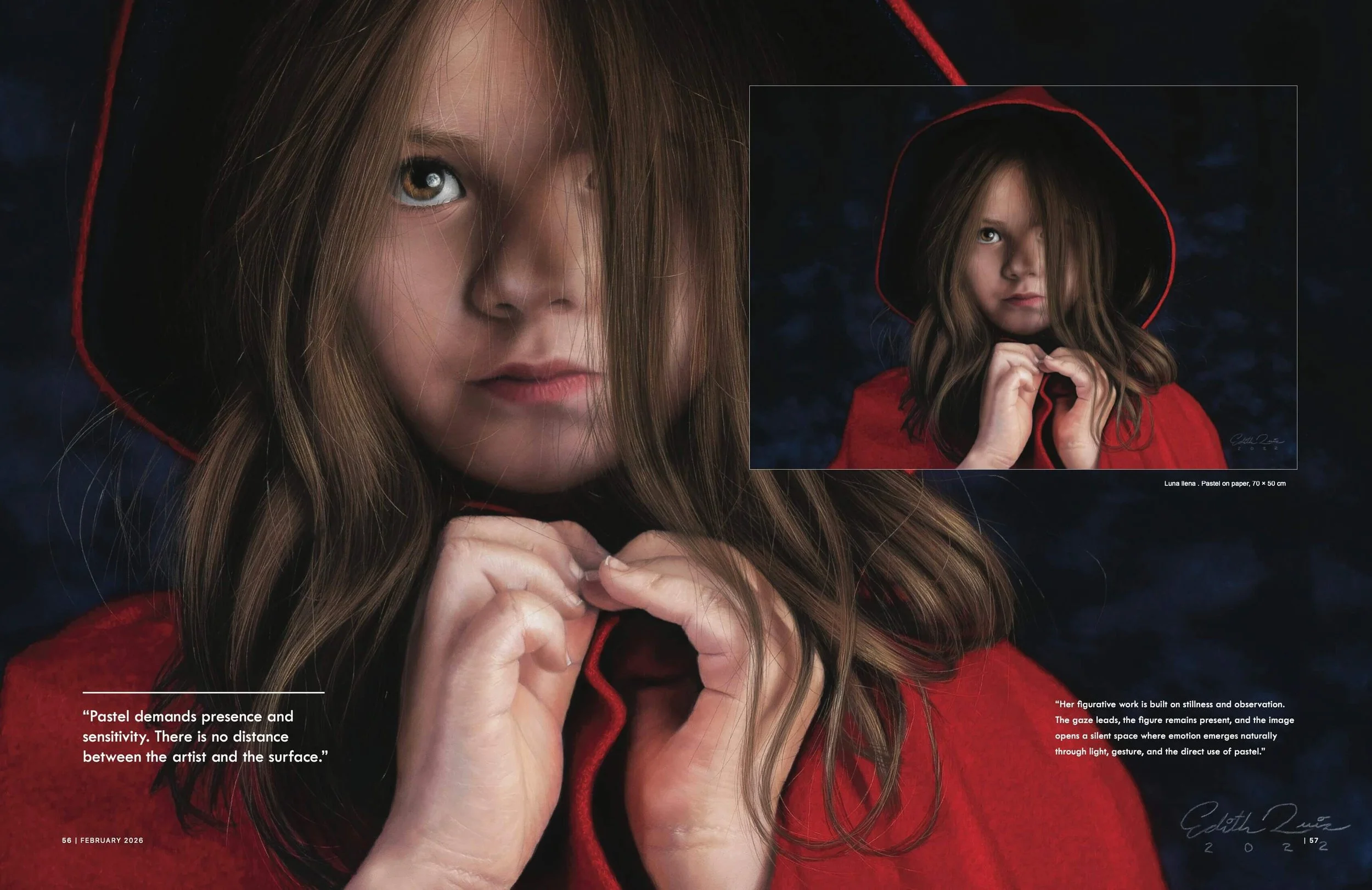
I observe the contrasts between light and shadow and pay close attention to textures, whether in different fabrics, smooth or wrinkled skin with its imperfections, or the way light reflects on animal fur or human hair. Attention to all of these details greatly contributes to the realistic impact of the work.
Of all the works you have created so far, is there one that represents a turning point in your artistic career, and why?
It is difficult to single out one work as a definitive turning point in my artistic career. What I can say is that I enjoy seeing how my way of painting has evolved over the years, eventually leading me to develop my own style, born from the combination of techniques learned from different masters. Each piece reminds me of a stage in my life and of my growth, both personal and artistic. That is what makes them all special to me.
You have had the opportunity to exhibit your work in different contexts and countries. How would you describe the experience of presenting your work
to diverse audiences, and what lessons has it taught you?
I feel fortunate for the opportunities I have had to exhibit my work outside of Mexico. It is exciting to present my pieces alongside artists from different countries. There are always expectations. Which new artist will I meet? What works will well known artists present? Which friends will I see again?
While I always learn valuable tips related to pastel materials or techniques, the greatest lesson I take away from these events is human in nature.
I have learned that although art is a personal form of expression, there is a remarkable similarity among artists of different nationalities, backgrounds, and life experiences. Sharing time with such diverse people, yet with so much in common, is what I value most.
From your perspective, what role do collective and solo exhibitions play in an artist’s professional and personal growth?
Exhibiting work, whether collectively or individually, unquestionably contributes to both personal and professional growth. It means making something intimate public and opening it up to the critique of many people.
I believe that no matter how many exhibitions one has participated in, there is always a mix of emotions: happiness, nervousness, enthusiasm, doubt, and hope.
An exhibition requires planning and preparation, discipline, organization, and a great deal of effort. All of this contributes to the artist’s overall growth.
When comparing your earliest works with your most recent ones, what significant changes do you notice in your technique, themes, and form of expression?
Experimenting with different ways of applying pastel, as well as with a variety of materials, has allowed me to refine details in skin textures, fabrics, fur, and objects. It has been enjoyable to become more creative by paying greater attention to clothing, settings, and models, and even by incorporating a touch of fantasy into some works.
Looking ahead, which artistic projects excite you most at this new stage of your career, and what would you like to explore on a technical or conceptual level?
I enjoy every part of the process behind creating the characters for my work. Choosing the model, clothing, and setting I want to paint is just as important as the painting itself. Bringing an idea into physical form and seeing it in front of me during the photographic study is deeply rewarding.
I am open to using currently available technology to add creative touches to my work, while always keeping a real model or character as the core element. I am excited to bring several new ideas to life in the near future.
Beyond exhibitions and the studio, what place does art occupy in your everyday life and in the way you understand the world?
Art has played a very significant role in my life. Choosing to follow my passion led me to face challenges I never imagined. It has helped me get to know myself and understand my emotions. It has shown me my fears and taught me about my weaknesses, motivations, and strengths.
I discovered the meaning of sharing experiences and knowledge. Art taught me the value of giving and of open, selfless relationships. Today, I understand that everyone who crosses my path does so for a reason, always bringing something that enriches me, and that there are no coincidences.
Finally, if you had to define your work and your relationship with art in a single sentence, what would it be and why?
I like to think of my work as an expression of life. It is a form of expression full of energy, one that generates sensations and diverse connections in me and in each viewer.
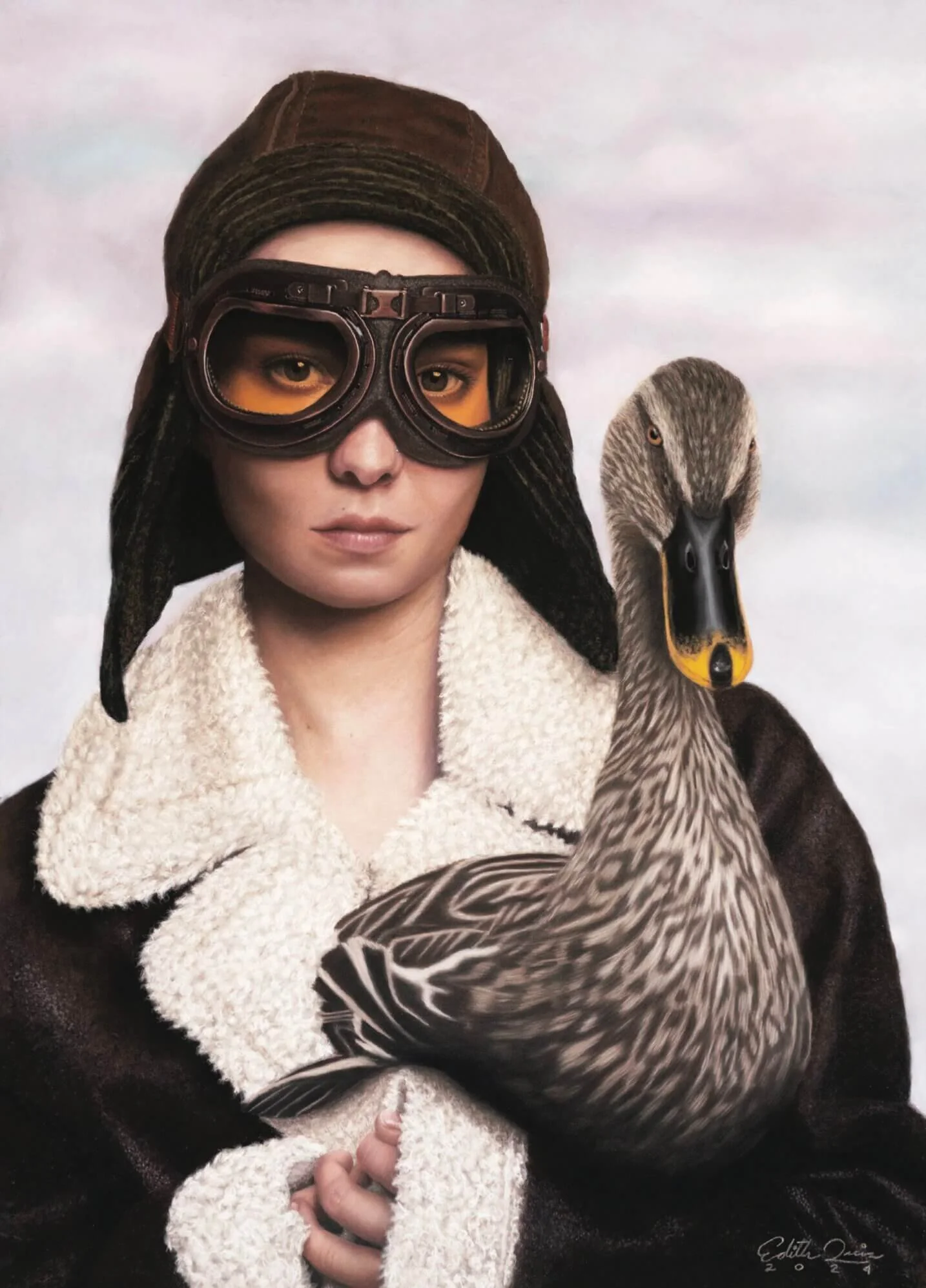
COVER : Guardiana . Pastel on paper, 70 × 50 cm