The Art Pick . Hiroki Fukuda (Dreaming Girl)
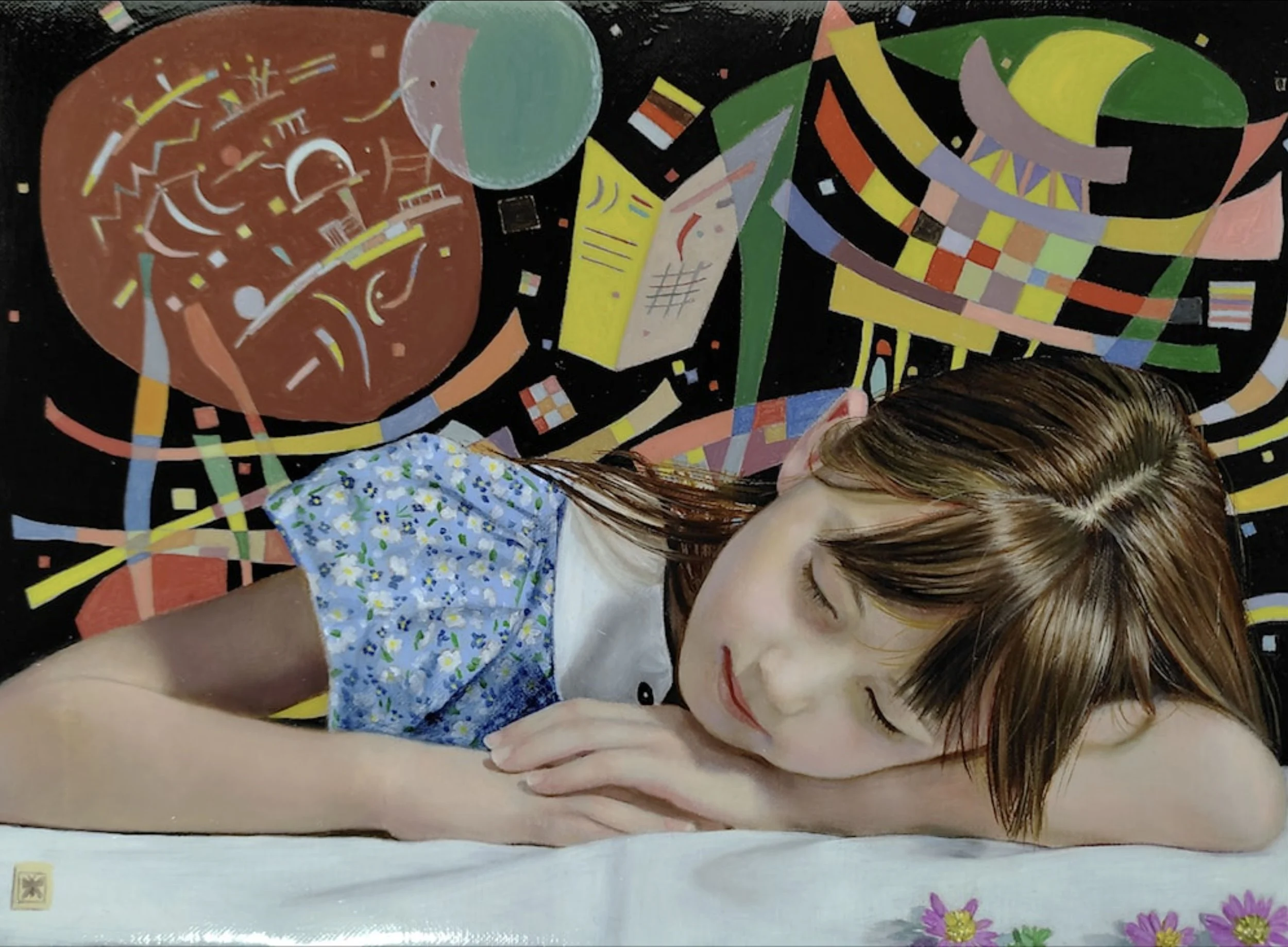
Dreaming Girl . 23 x 33 cm . Oil painting on canvas on board
Dreaming Girl . 23 x 33 cm . Oil painting on canvas on board
In Dreaming Girl (2024), Hiroki Fukuda develops a profound meditation on the relationship between the visible world and the boundless territory of the imagination. Through the deliberate coexistence of two pictorial languages historically regarded as opposing forces, the artist establishes a sophisticated dialogue between meticulous figuration and geometric abstraction. The result transcends the conventional boundaries between representation and nonrepresentation, transforming the pictorial surface into a space where physical reality and the immaterial dimensions of consciousness converge.
What makes this work particularly compelling is not simply the juxtaposition of contrasting visual approaches, but the internal coherence that emerges from their interaction. Fukuda brings together the precision of academic realism and the expressive freedom of abstraction without allowing either language to dominate the other. Instead, both operate in a relationship of interdependence. The figurative element provides a point of physical and emotional grounding, while the abstract field opens the composition toward a more elusive dimension of experience—one that resists literal description and exists primarily through sensation, association, and the fluid logic of the mind.
This relationship gives Dreaming Girl its distinctive conceptual depth. Rather than presenting realism and abstraction as separate artistic territories, Fukuda suggests that they may constitute complementary ways of apprehending reality. The former describes the external world through observation and material specificity; the latter evokes the inner world through rhythm, color, geometry, and intuitive perception. From this perspective, the painting becomes an exploration of the complex relationship between what can be seen and what can only be experienced.
In the lower portion of the composition, a young girl rests peacefully along the edge of the pictorial surface. Her presence introduces an immediate sense of stillness, intimacy, and human vulnerability. Fukuda’s treatment of the skin reveals an extraordinary sensitivity to subtle tonal variations, while the delicate fall of her hair, illuminated by grazing light, demonstrates a precise understanding of the interplay between light and form. The intricate details of her floral dress further underscore the artist’s technical discipline and deep engagement with the traditions of representational painting.
Yet the significance of this figure extends far beyond the demonstration of technical virtuosity. Her quiet presence establishes the emotional center of the composition, offering the viewer a recognizable point of entry into an otherwise expansive and enigmatic visual universe. She occupies a threshold between physical presence and psychological withdrawal, between the immediate experience of the body and the mysterious activity of the mind during sleep. Her repose suggests a temporary suspension of conscious engagement with the external world—a moment in which perception turns inward and reality begins to yield to the imagination.
Fukuda’s decision to position the figure along the lower edge of the composition reinforces this sense of transition. The girl remains grounded in the physical world, while the extraordinary visual environment unfolding above her appears to belong to another order of experience. The painting thus establishes a subtle but consequential distinction between the body at rest and the mind in motion. While the figure remains still, the abstract forms above her suggest an inner world characterized by movement, transformation, and seemingly limitless possibility.
Emerging from a deep black ground, the abstract field unfolds as a constellation of geometric forms, intersecting grids, arches, circles, and chromatic rhythms. Its visual language evokes aspects of the vocabularies associated with Vassily Kandinsky and Joan Miró, particularly their respective explorations of abstraction as a means of articulating inner experience, intuitive associations, and alternative forms of visual organization. These affinities offer a useful point of reference for understanding Fukuda’s composition, although the work ultimately establishes its own distinctive relationship between geometric structure and expressive freedom.
The black background plays an essential role in this visual construction. Far from functioning as a mere negative space, it creates an expansive field in which individual forms appear to emerge, move, and establish relationships with one another. The surrounding darkness intensifies the luminosity of the colors and sharpens the contours of the geometric elements, allowing each shape to retain its individuality while contributing to the overall rhythm of the composition. The result is a visual environment that appears simultaneously ordered and unpredictable, governed by a discernible formal logic yet open to multiple interpretations.
This tension between structure and spontaneity lies at the heart of the painting’s expressive character. Grids and geometric divisions suggest systems of organization, measurement, and rational thought, while the diversity of shapes and chromatic relationships introduces an intuitive movement that resists complete formal containment. The composition evokes a world in which logic and imagination are not mutually exclusive but remain in continuous negotiation. As Fukuda’s painting suggests, the mind can generate extraordinary visual complexity through the simultaneous interaction of order, memory, emotion, and free association.
Within this context, abstraction assumes a psychological dimension. The forms above the sleeping girl may be understood as a visual interpretation of the dream state, in which familiar objects and experiences are released from their ordinary functions and reorganized according to associations that may be emotional, symbolic, or entirely intuitive. The principles governing waking perception—proportion, continuity, spatial consistency, and causality—appear to loosen their hold. In their place emerges a more fluid system of relationships, in which images can transform, overlap, and coexist without requiring a stable or literal explanation.
Fukuda does not attempt to illustrate a specific dream or construct a clearly defined narrative. His approach is more suggestive: he establishes the visual conditions through which the viewer may recognize the experience of dreaming itself. The abstract field remains open-ended, refusing to settle into a single interpretation or predetermined symbolic meaning. Its significance lies precisely in this ambiguity. Like dreams, the forms invite associations without confirming them, allowing individual memories and emotional responses to become part of the viewing experience.
This interpretive openness establishes a particularly compelling relationship between the artist’s imagination and that of the viewer. The abstract elements may evoke specific images, memories, or sensations, yet these associations are unlikely to be identical for every observer. One viewer may perceive an architectural structure, another a celestial map, and another a constellation of forms connected to deeply personal experiences. None of these readings necessarily exhausts the work’s possibilities. Instead, each contributes to the broader interpretive space that the composition makes available.
This quality distinguishes Dreaming Girl from a strictly illustrative approach to the subject of sleep. Rather than defining dreams through recognizable symbols or conventional narrative devices, Fukuda approaches them as a state in which meaning remains provisional and perception becomes especially receptive to transformation. The painting does not reveal what the girl is dreaming. Instead, it invites us to consider the nature of a consciousness capable of producing images that are deeply personal yet visually expansive.
Color contributes significantly to this sense of psychological freedom. Against the black ground, the chromatic elements acquire heightened intensity, establishing rhythms that guide the eye across the composition. Their relationships generate a visual pulse that contrasts with the stillness of the sleeping figure below. Color becomes more than a descriptive or decorative device; it operates as an independent expressive force, capable of suggesting energy, tension, harmony, and emotional resonance without relying on literal representation.
The geometric forms similarly demonstrate how abstraction can create a sense of movement without depicting physical action. Arches, circles, and intersecting lines establish visual pathways that encourage the eye to travel from one element to another. These movements are not linear in the conventional narrative sense. Rather, they are associative, producing connections through visual proximity, formal repetition, and chromatic contrast. In this respect, the composition evokes the workings of memory and imagination, in which one image may unexpectedly call forth another, creating networks of meaning that do not necessarily follow a chronological or rational sequence.
The contrast between the sleeping figure and the abstract universe also introduces a subtle meditation on the relationship between stillness and activity. The body appears tranquil, almost suspended in time, while the visual field above it suggests a continuous process of formation and transformation. This opposition, however, is not absolute. The stillness of the figure intensifies the vitality of the imagined world, just as the dynamism of the abstract forms lends psychological significance to her repose. Each element derives part of its meaning from its relationship with the other.
The material dimension of the painting is equally significant. Executed in oil on canvas mounted on board, Dreaming Girl brings together the expressive possibilities of the medium and the physical stability of its support. Oil paint allows for subtle tonal transitions, controlled detail, and a richly developed surface, qualities particularly evident in the rendering of the girl’s features, hair, and clothing. At the same time, the material density of the painted object introduces a compelling paradox: an experience associated with impermanence, instability, and the elusive movement of thought is translated into a lasting physical presence.
Dreams are inherently difficult to preserve. Their images may disappear almost immediately upon waking, leaving behind only fragments, impressions, or emotions whose original context has already begun to dissolve. Painting offers another possibility. Through the deliberate organization of color, form, and material, the artist gives visual permanence to an experience that is fundamentally transient. The dream remains intangible as an event, yet its imagined structure acquires a tangible presence through the artwork.
This tension between the fleeting and the enduring is among the painting’s most resonant qualities. The viewer encounters a physical object that seems to open onto a psychological space, a carefully constructed image that evokes something spontaneous and beyond complete control. The material surface becomes the meeting point between two seemingly incompatible conditions: the permanence of the artwork and the ephemeral nature of the experience it evokes.
The use of canvas mounted on board further reinforces the relationship between pictorial illusion and physical reality. The work presents an imagined universe, yet it remains firmly rooted in the material world of paint, support, and surface. Its abstract forms may evoke an expansive psychological space, but they remain contained within the boundaries of a finite object. This tension between the expansive and the contained reflects one of painting’s fundamental paradoxes: the capacity of a bounded surface to suggest worlds that extend far beyond its physical dimensions.
Even the composition’s more understated details contribute to this carefully balanced relationship. The flowers arranged along the lower edge introduce a delicate reference to the natural world, echoing the floral pattern of the girl’s dress while establishing a subtle connection between the figurative and abstract elements. Their presence reinforces the impression that the boundary between the external environment and the dream state is not entirely impermeable. The imagined world does not necessarily remain separate from reality; it may emerge from it, transform it, and eventually return to it in an altered form.
These details also encourage us to read the composition as a liminal space—a zone of transition in which distinct states of being begin to overlap. The girl occupies the threshold between wakefulness and dreaming, while the painting itself occupies a comparable position between representation and abstraction. Both relationships depend on a condition of ambiguity that invites the viewer to consider not only the differences between opposing states but also the subtle ways in which they influence and penetrate one another.
Within the broader context of contemporary painting, Dreaming Girl is particularly compelling for its refusal to treat technical realism and abstract expression as mutually exclusive artistic positions. The work demonstrates that meticulous observation and imaginative freedom can coexist within a single pictorial language. Its realism does not confine the composition to the visible world, just as its abstraction does not entirely sever it from recognizable human experience. Instead, the two approaches become interdependent, allowing the painting to move between the tangible and the psychological without sacrificing its compositional coherence.
This synthesis also raises important questions about the nature of artistic representation. If a realistic image can establish a convincing sense of physical presence, and an abstract configuration can evoke the complexity of an inner experience, then painting possesses the capacity to operate across different registers of perception simultaneously. It can describe, suggest, evoke, and transform. It can render the visible world recognizable while allowing the invisible dimensions of experience to acquire a form of visual presence.
Fukuda’s achievement lies in bringing these possibilities together without reducing the work to a theoretical proposition. The painting remains grounded in its visual qualities: the precision of its figurative passages, the contrast between darkness and color, the rhythmic organization of geometric forms, and the careful balance between compositional stillness and expressive movement. Its conceptual dimension emerges through these artistic decisions rather than existing independently of them. The ideas it raises are inseparable from the act of painting itself.
Ultimately, Dreaming Girl invites us to reconsider the boundary between perception and imagination. We often regard the waking world as the domain of objective reality and the dream as a temporary departure from it—a private experience whose images dissolve under the scrutiny of consciousness. Fukuda’s composition complicates this distinction. By placing a recognizable human figure beneath an expansive abstract universe, he suggests that inner life is not necessarily secondary to external reality. It possesses its own structures, rhythms, and forms of coherence, even when these cannot be translated into the stable language of conscious thought.
The work also invites a more intimate reflection on the act of looking. As viewers, we move between the girl’s recognizable physical presence and the abstract field surrounding her, shifting between different modes of interpretation. We observe the figure through the language of representation, then encounter the geometric forms through intuition, association, and emotional response. The experience of viewing the painting thus echoes its central subject: the movement between what can be identified and what remains open to possibility.
Selected for The Art Pick by The Guide Artists, Hiroki Fukuda’s Dreaming Girl stands out for its technical refinement, its thoughtful integration of contrasting pictorial languages, and its exploration of the fragile relationship between the physical world and the inner life. It is a work that rewards sustained attention, revealing how the precision of representation can coexist with the indeterminacy of abstraction, and how a seemingly quiet scene can contain an expansive field of psychological and philosophical inquiry.
Beyond its formal sophistication, the painting leaves us with a question that extends far beyond the subject of sleep: if the resting mind can generate worlds of such vividness, complexity, and internal coherence, where, precisely, does the boundary lie between what we perceive with our eyes open and what we construct from within? Perhaps the distinction is less absolute than we assume. Perhaps the imagination does not simply escape reality but continually reshapes our understanding of it.
In Dreaming Girl, painting becomes the space in which these two dimensions meet—not as opposing territories, but as interconnected expressions of human experience. What begins as the image of a sleeping child ultimately opens onto a much broader meditation on consciousness, perception, and the extraordinary capacity of the mind to transform stillness into a universe of possibilities.